
The FOAM Series
A four-volume practitioner library for the people who actually run and govern common interest communities. One series, four seats — manager, volunteer director, accounting, operations.
Founders' pricing locks in 44 days. See what closes 2026-07-31.
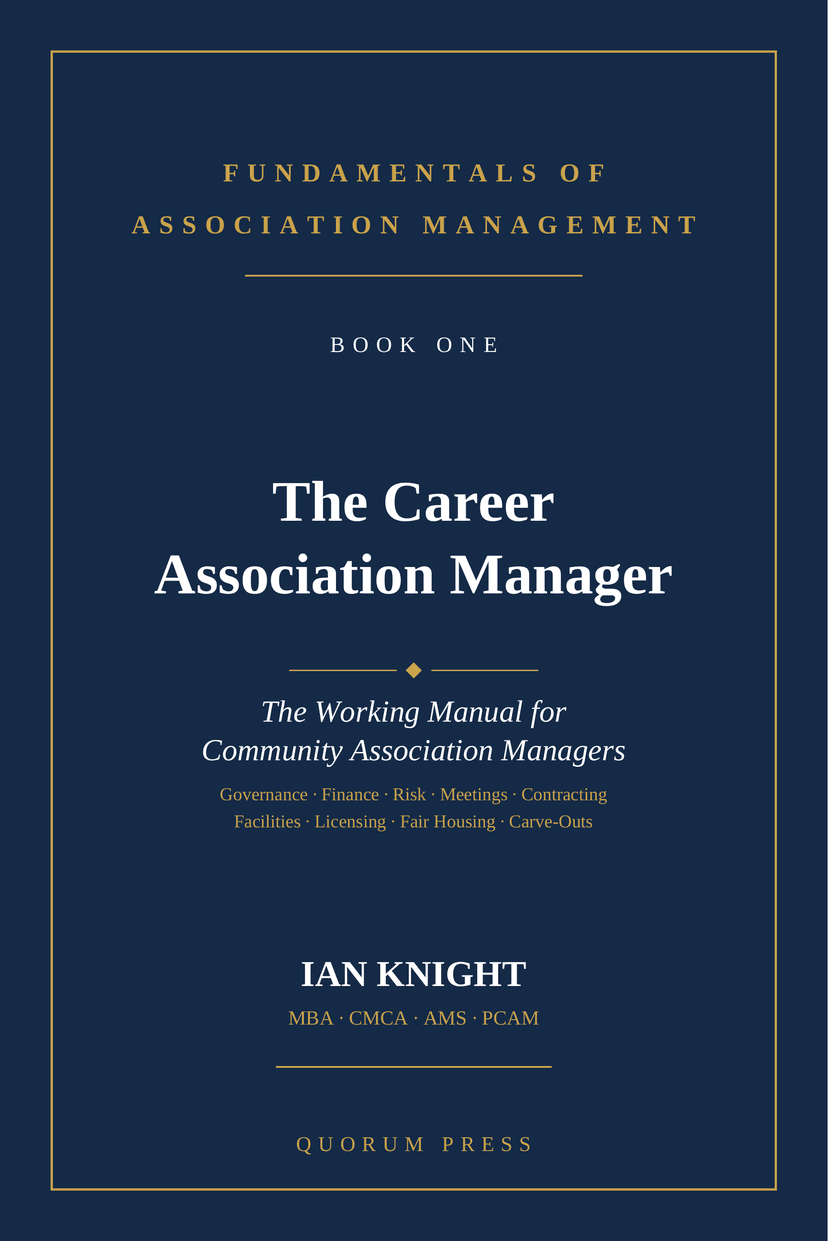
The Career Association Manager
The Working Manual for Community Association Managers
Book One
Ships July 2026
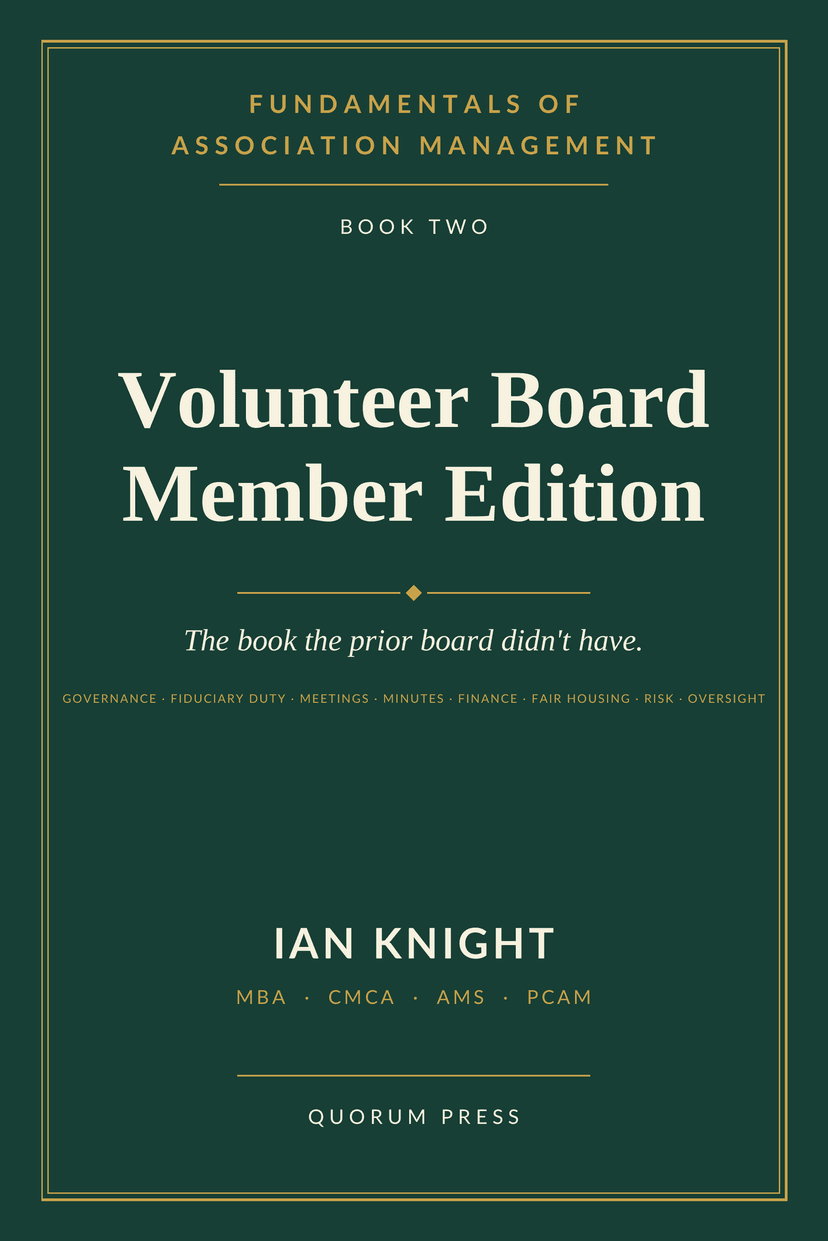
The Volunteer Board Member
The Seat You Didn't Train For
Book Two
Ships July 2026
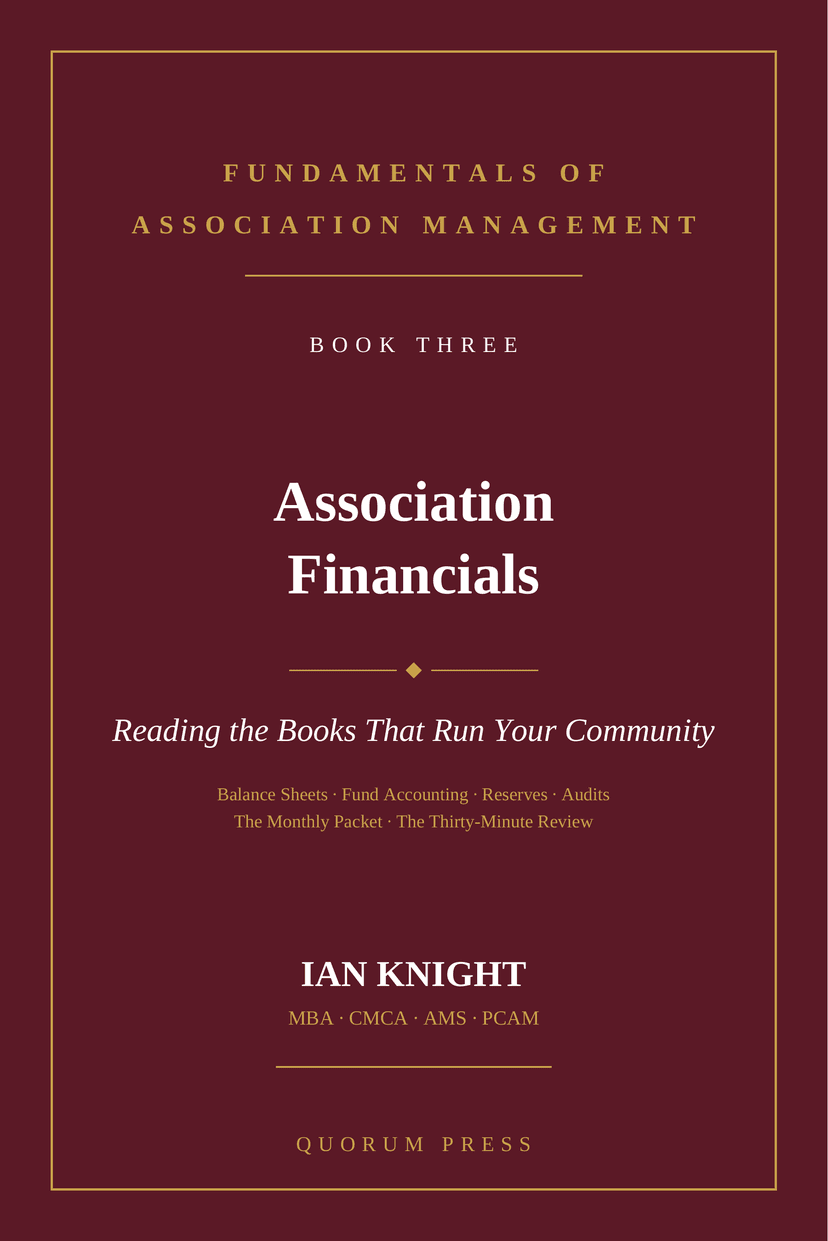
Association Financials
What the Money Is Telling You
Book Three
Ships August 2026
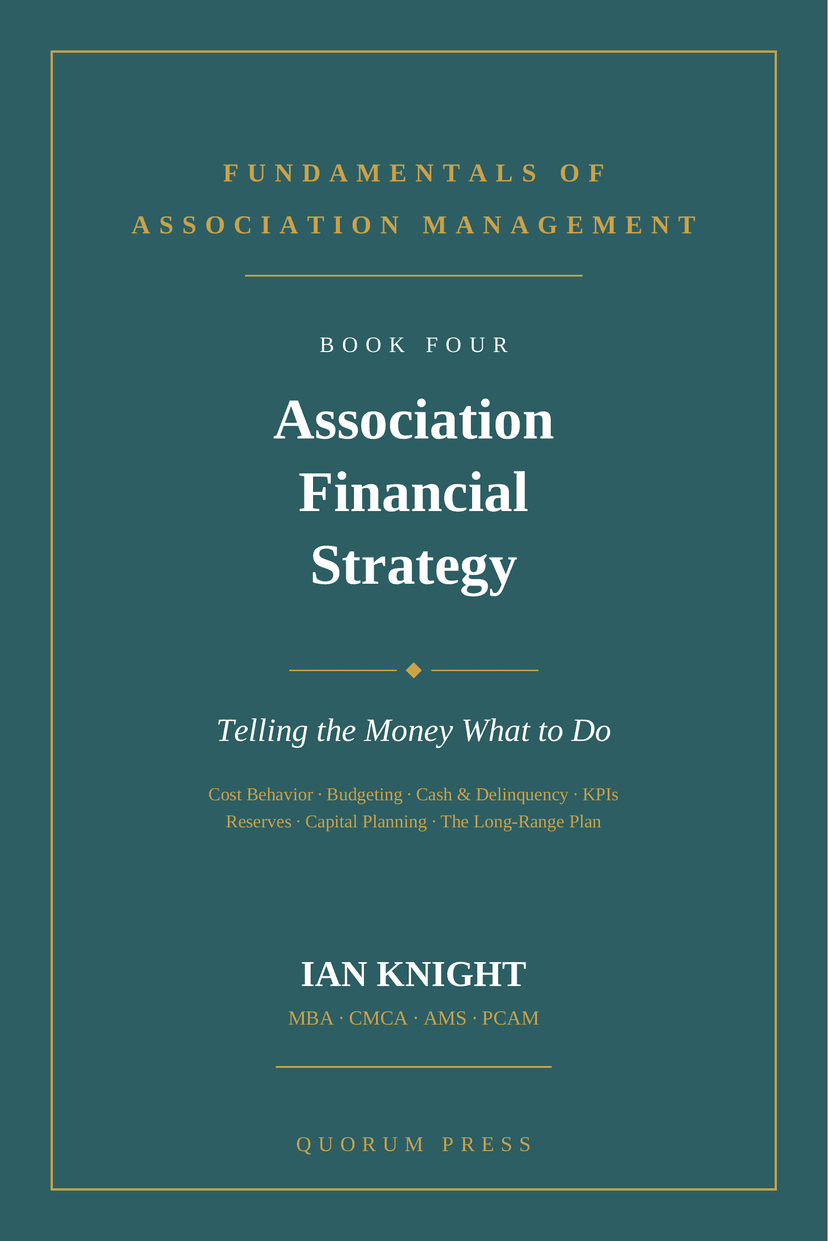
Association Financial Strategy
Telling the Money What to Do
Book Four
Ships September 2026
One unified learning system for the volunteer directors and professional managers who carry the work of America's community associations.
What is FOAM?
FOAM — Fundamentals of Association Management — is the educational content brand of CICSC. The series is the bound, bookshelf form of the same governance reference that the CIC-BOS credential teaches.
Each volume is self-contained but written so that managers, directors, and accounting staff can hand books to one another and remain in the same vocabulary.
Published by Quorum Press, an imprint of Texas Active Enterprise, LLC.
Complete FOAM Library
All four volumes — the manager's manual, the board member's guide, and both financial titles.
Save $44.97 — 26% off buying each volume separately.
Founders' pre-launch price. Rises to $139.99 when the Founders' window closes in 44 days.
The Four Volumes
Choose the seat. Each book stands on its own. Reserve copies of upcoming volumes now and you'll be first when they ship.
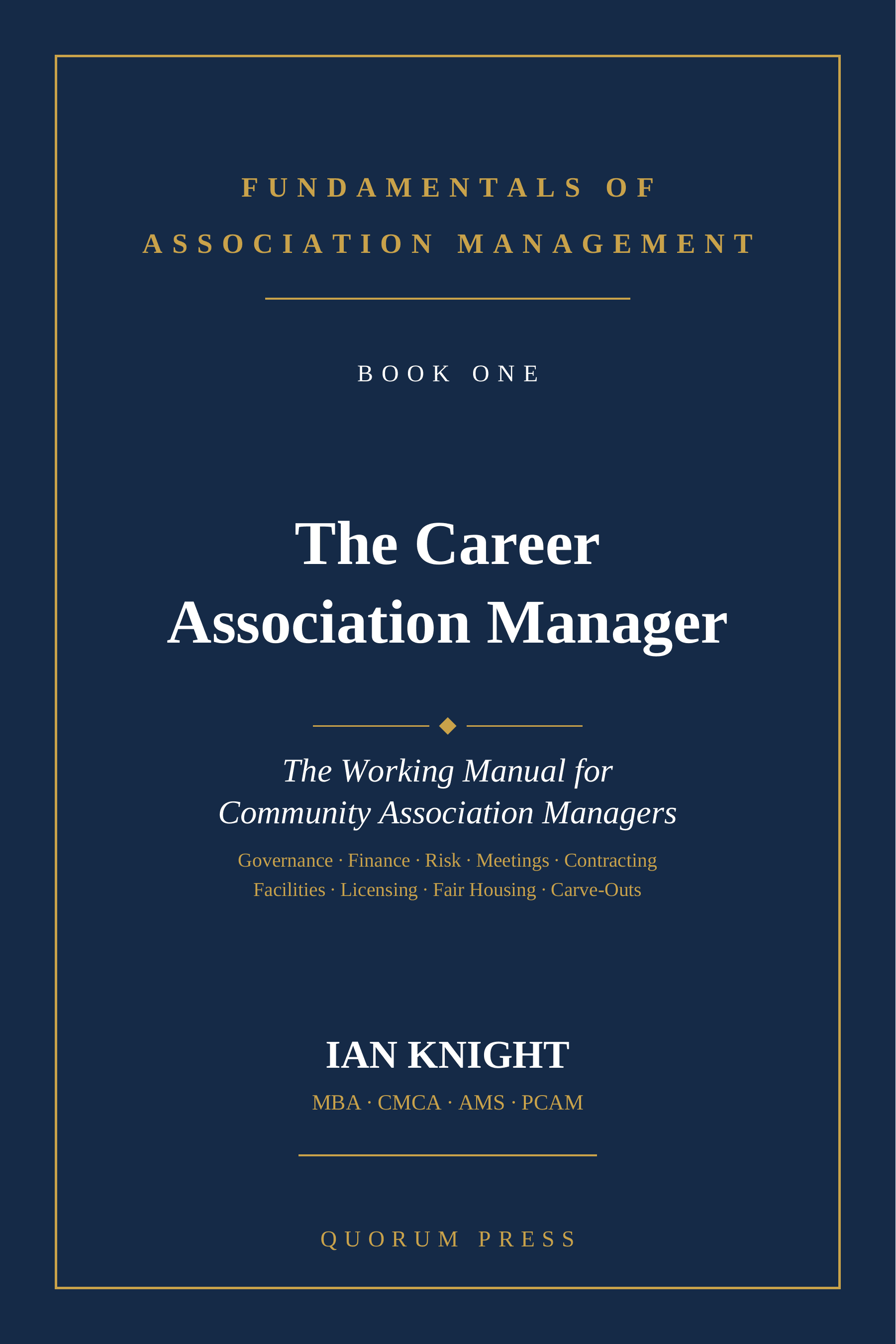
The Career Association Manager
The Working Manual for Community Association Managers
For the community-association manager who has chosen this work as a career.
The working manual for the person who chose association management as a career — not a job they fell into. From the governing documents beneath every decision to budgets, enforcement, meetings, vendors, maintenance, licensing, and fair housing at the front desk, it covers the full practitioner's craft in plain language built for the field, not the classroom.
- 1.The Rules Beneath the Lawn
- 2.Following the Money
- 3.When Things Go Wrong
- 4.Getting People in a Room
- 5.Hiring the Work Out
- 6.Keeping the Place Standing
- 7.Fair Housing on the Front Desk
- 8.The Things Boards Can't Ban Anymore
- 9.Getting Licensed: Do You Even Need To?
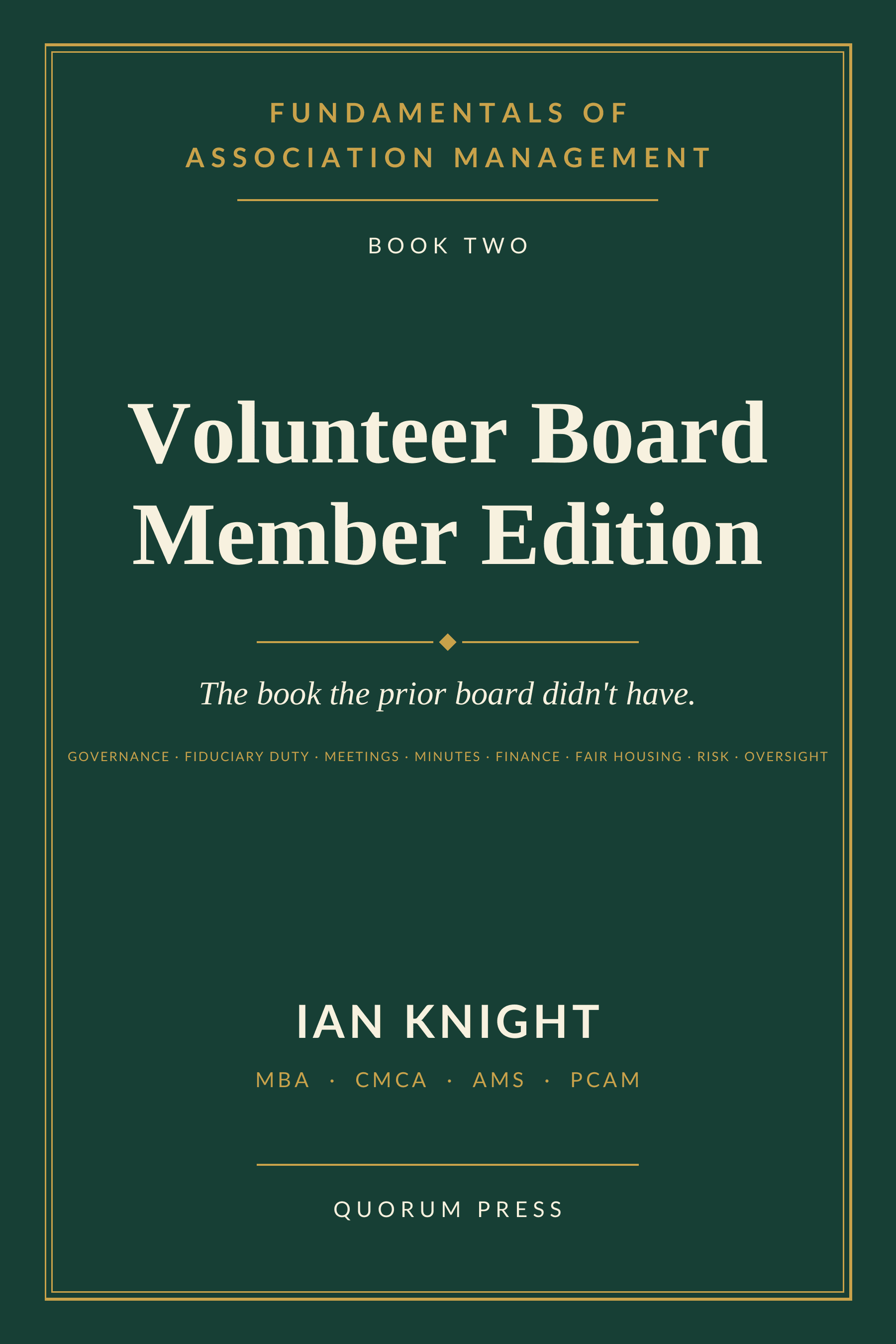
The Volunteer Board Member
The Seat You Didn't Train For
For the volunteer director who took the seat without the training the seat requires.
Written for the director who took the seat without the training the seat requires. It traces where a board member's authority actually comes from, how the liability shield works, and what really happens on a Tuesday night — from running a meeting and keeping minutes to guarding the money, saying no to a neighbor, and handling fair housing, insurance, and the moments when it all goes wrong.
- 1.The Seat You Didn't Train For
- 2.Where Your Authority Actually Comes From
- 3.The Shield
- 4.Tuesday Night
- 5.The Secretary's Craft
- 6.Committees and Resolutions
- 7.The Money You're Guarding
- 8.The Treasurer's Chapter
- 9.Saying No to a Neighbor
- 10.Fair Housing on a Tuesday Night
- 11.The Things You Can't Ban Anymore
- 12.The People You Hired and the Work You Contract Out
- 13.Risk, Insurance, and Exposure
- 14.When It Goes Wrong
- 15.Leaving It Better
- 16.Why We Serve
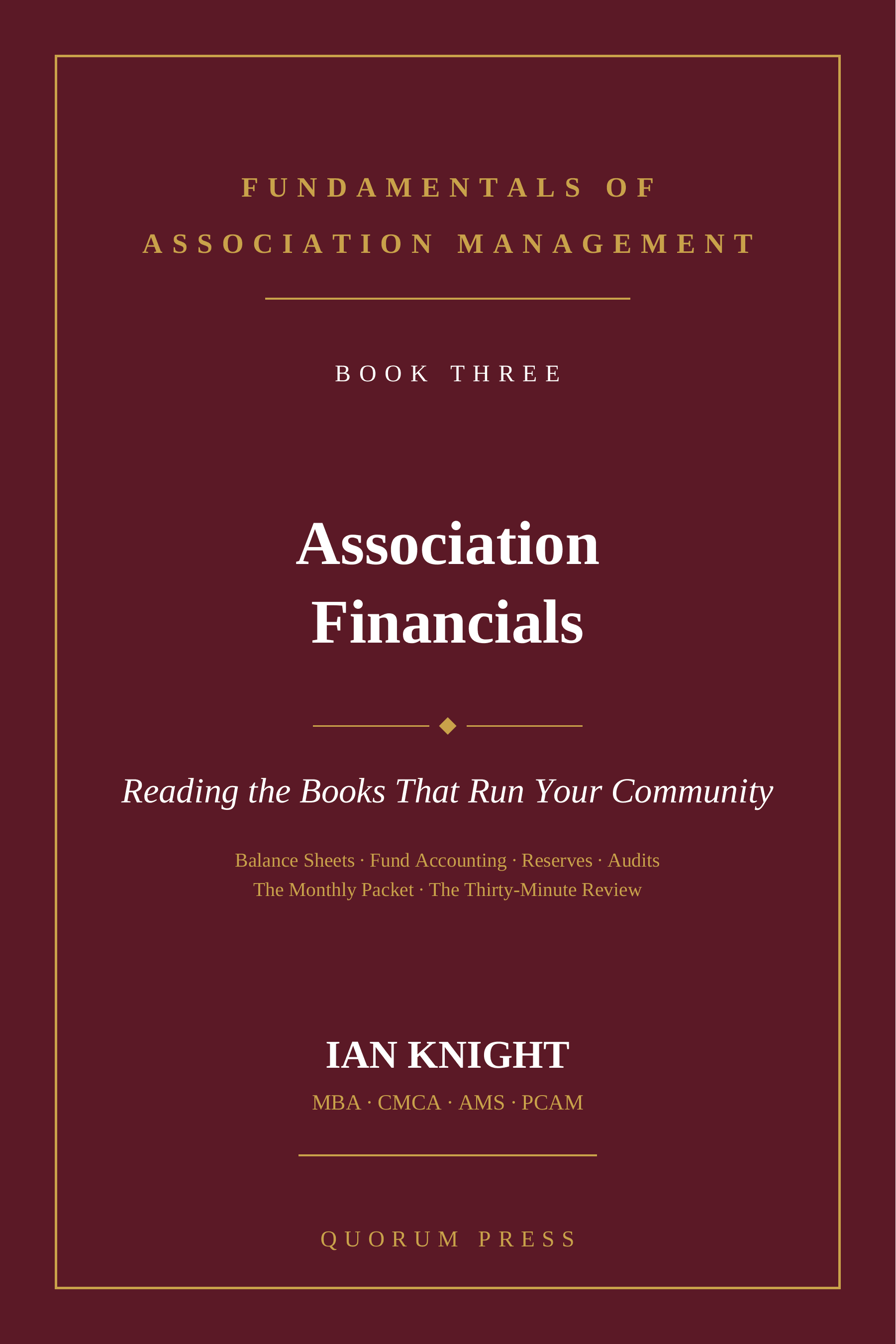
Association Financials
What the Money Is Telling You
For the board, manager, or accountant who needs to read a financial statement and know what it means.
A plain-English guide to reading an association's financial packet and knowing what it means. It builds from the accounting equation up through the five documents that run every monthly packet — balance sheet, income statement, general ledger, AR aging, and bank reconciliation — and ends with a thirty-minute review any board member or manager can run with confidence.
Part I — The Discipline
- 1.Why Association Accounting Is Its Own Discipline
- 2.The Equation, Debits, Credits, and What Hits the Ledger
- 3.Cash vs. Accrual and the Chart of Accounts
Part II — The Five Documents That Run the Packet
- 4.The Balance Sheet, Fund by Fund
- 5.The Income Statement — Operating, Reserve, and the Twelve-Month View
- 6.The General Ledger, AR Aging, AP Register, and Bank Reconciliation
Part III — Reading, Reconciling, and Speaking
- 7.When the Numbers Don't Tie
- 8.Year-End: Audits, Reserve Studies, Resale Certificates
- 9.The Thirty-Minute Review and the Conversation with Your Board
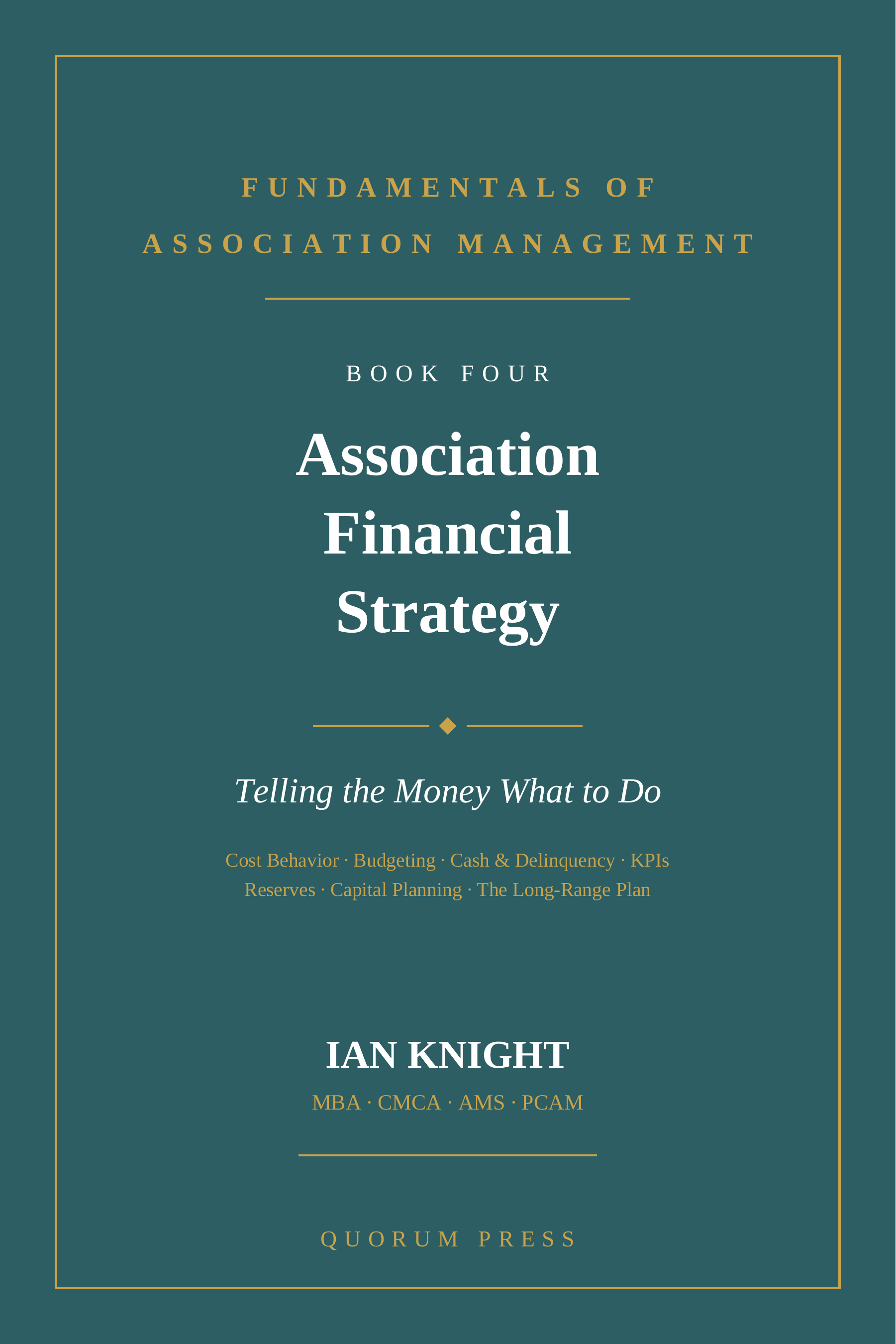
Association Financial Strategy
Telling the Money What to Do
For the board, manager, or accountant who builds the budget and chooses where the money goes.
The companion to Association Financials: where the first book teaches you to read the money, this one teaches you to direct it. It covers cost behavior, the assessment decision, and building a budget that decides rather than just balances, then moves into reserves, capital planning, special assessments, and communicating a long-range financial plan a board can stand behind.
Part I — The Manager's Lens
- 1.Why Managerial Accounting Looks Different in a Nonprofit Community
- 2.Cost Behavior and Expense Structure in Associations
- 3.Income Planning and the Assessment Decision
Part II — Budgeting as a Management System
- 4.Building a Budget That Decides, Not Just Balances
- 5.Cash Flow, Liquidity, and Delinquency as Strategy
- 6.Variance, Indicators, and Diagnosing What the Community Is Telling You
Part III — Long-Range Stewardship
- 7.Reserve Studies as Managerial Tools
- 8.Capital Budgeting, Special Assessments, and Differential Analysis
- 9.Communicating Financial Meaning and Delivering the Long-Range Plan

Ian KnightMBA · CMCA · AMS · PCAM
About the Author
Ian Knight, MBA, CMCA, AMS, PCAM, is a community association executive, industry researcher, and educator with experience across all types of community associations, including master-planned communities, single-family homeowners associations, condominiums, townhome associations, and mixed-use developments. His background spans governance, financial oversight, vendor management, and day-to-day operational leadership, bringing a practical, systems-based approach to association management.
In addition to executive leadership experience, Ian contributes to the advancement of the industry through ongoing subject matter expert work, independent research, and volunteer service focused on improving professional standards, education, and operational consistency within community associations.
Through Texas Active Enterprise, he developed the FOAM (Fundamentals of Association Management) education series to bridge the gap between volunteer boards and professional managers by translating complex governance, operational, and financial concepts into clear, actionable frameworks.
His work focuses on improving decision-making, strengthening financial literacy, and building repeatable operational systems across community associations. His teaching approach emphasizes real-world application, disciplined execution, and clarity — helping boards and managers understand not only what to do, but how to do it effectively in practice.
Subject Matter Authority
Ian’s perspective is shaped by a foundation in business and finance. He holds a Bachelor of Science in Marketing — with coursework spanning business finance, accounting, economics, and data analytics — from the Lutgert College of Business at Florida Gulf Coast University, and a Master of Business Administration focused on business strategy and project management from Louisiana State University Shreveport, both AACSB-accredited institutions.
On the practitioner side, Ian holds the field’s principal professional credentials — Certified Manager of Community Associations (CMCA), Association Management Specialist (AMS), and Professional Community Association Manager (PCAM) — and is a licensed Community Association Manager in Florida. That combination of academic grounding and day-to-day management experience is what allows the FOAM series to move comfortably between the why and the how.
Ian also works to strengthen the profession beyond his own portfolio. He contributes to the Common Interest Community Standards Council, and his research paper, “The Five Stages of the American Community Association: An Organizational-Lifecycle Framework for Governance, Operations, and Policy,” introduces the lifecycle model that informs much of his teaching.
Ian is the author of the four-volume Fundamentals of Association Management (FOAM) series, published by Quorum Press, an imprint of Texas Active Enterprise.
Disclaimer: CICSC provides educational resources, governance standards, and practical advisory support. CICSC does not provide legal advice, accounting advice, tax advice, engineering advice, insurance advice, or reserve study services. Board members and associations should consult qualified professionals for matters requiring professional judgment or legal interpretation.